If you like amoral assassins, boarding schools from hell and more snark than you can poke a stick at, oh boy do I have the book for you.
Nevernight by Jay Kristoff is that rare, perfect blend of genres. It's as if someone lifted the School for Assassins out of Discworld, added a generous scoop of Locke Lamora, and just a sprinkling of David Eddings. (Look, there's a reason I don't write recipe books.)
The main protagonist is new initiate Mia Corvere at an infamous school for assassins. Not only are the lessons actively trying to kill her, but there's a limited number of graduate positions, meaning competition between students is insanely (read: fatally) high. On the plus side, if she survives, she's got steady career prospects in a high growth industry.
With Pratchett-style footnotes and snide undercuts of dramatic moments, Nightshade is a thoroughly entertaining read. However - and all credit to Jay Kristoff here - he never crosses the line into parody. The stakes remain high and the threats remain real. Rather than downplaying the danger, the humour serves to humanise the characters and stave off darkness-induced-apathy.
In fact, it's the characters who can't laugh at themselves who are the least sympathetic. Mia might be a budding killer with demonic powers and an ax to grind, but her bodycount is a drop in the ocean compared to the respectable citizens who run her world. They consider themselves perfectly righteous and will defend their dignity to the death, which makes them more dangerous than any number of poisons, blades or magic spells.
It's hard work making a murder-school look morally superior, but Kristoff pulls it off. He balances the pathos and laughs beautifully, and Mia comes off as fairly sympathetic despite her proclivity for stabbing people. If you're missing Arya Stark something chronic, Mia will fill the void nicely until the next episode of Game of Thrones.
Final Verdict: Awesome. Can't wait for the sequel.
"Whether any of this is true, of course, remains a matter of drunken speculation on the decks of various pork ships. What is true, is that after learning from Mercutio what exactly went on at the Porkery at age thirteen, a young Mia Corvere swore off eating ham for the rest of her life."
Sunday, 20 August 2017
Tuesday, 16 May 2017
Who's Afraid by Maria Lewis
Maria Lewis has a new book out, which makes it a good time to go back to her first urban fantasy novel Who's Afraid.
The protagonist Tommi is a young woman seeking out her birth family in New Zealand, only to stumble across a world-shattering secret. (Spoiler alert: she's a werewolf). Said family reunion does not go well and now she must fight to defend herself and her loved ones.
There's a lot that's good about this book. Its premise is similar to Kelly Armstrong's Otherworld series - young woman undergoes traumatic initiation to the supernatural community - but it approaches the subject matter in its own unique way. Sometimes I'd argue a better way. For example, when your family knocks you out and locks you in a cage, it's not for your own good. They're just assholes.
However the book is undermined by its jarring tones. Tommi's light breezy narrative clashes with the trauma she undergoes, and not in a 'bad things happen to good people' kind of way. More as if it can't decide what kind of story it wants to tell. Halfway through a riveting tale of abduction and escape, the book takes a sharp turn into paranormal romance.
To be clear, there's nothing wrong with paranormal romance. Nor is there anything wrong with dark and deconstructive. In this instance, the combination just doesn't work well together.
It's hard to care about Tommi's forbidden relationship with the mysterious Lorcan when the first half of the book worked so hard to set up her conflict with her family. Lorcan works perfectly well as a mentor figure and exposition-giver. But as a love interest, he offers nothing I haven't see a hundred times already and - if I'm being completely honest - comes off as kind of skeevy, given what Tommi just went through.
Finally, I found the presentation of Maori culture problematic, similar to Stephanie Meyer's appropriation of Quileute beliefs. For a more indepth outline, see this article which articulates it far better than I ever could.
There's a good story in Who's Afraid, about a vicious fight for survival and families of choice versus blood. Unfortunately it focuses on the least interesting aspect, making it a rather frustrating read. I may get round to the sequel eventually, but I'm not exactly panting for it.
Final Verdict: Okay. Has good stuff, but I'd like it better if it could follow through on the grittiness of its premise.
The protagonist Tommi is a young woman seeking out her birth family in New Zealand, only to stumble across a world-shattering secret. (Spoiler alert: she's a werewolf). Said family reunion does not go well and now she must fight to defend herself and her loved ones.
There's a lot that's good about this book. Its premise is similar to Kelly Armstrong's Otherworld series - young woman undergoes traumatic initiation to the supernatural community - but it approaches the subject matter in its own unique way. Sometimes I'd argue a better way. For example, when your family knocks you out and locks you in a cage, it's not for your own good. They're just assholes.
However the book is undermined by its jarring tones. Tommi's light breezy narrative clashes with the trauma she undergoes, and not in a 'bad things happen to good people' kind of way. More as if it can't decide what kind of story it wants to tell. Halfway through a riveting tale of abduction and escape, the book takes a sharp turn into paranormal romance.
To be clear, there's nothing wrong with paranormal romance. Nor is there anything wrong with dark and deconstructive. In this instance, the combination just doesn't work well together.
It's hard to care about Tommi's forbidden relationship with the mysterious Lorcan when the first half of the book worked so hard to set up her conflict with her family. Lorcan works perfectly well as a mentor figure and exposition-giver. But as a love interest, he offers nothing I haven't see a hundred times already and - if I'm being completely honest - comes off as kind of skeevy, given what Tommi just went through.
Finally, I found the presentation of Maori culture problematic, similar to Stephanie Meyer's appropriation of Quileute beliefs. For a more indepth outline, see this article which articulates it far better than I ever could.
There's a good story in Who's Afraid, about a vicious fight for survival and families of choice versus blood. Unfortunately it focuses on the least interesting aspect, making it a rather frustrating read. I may get round to the sequel eventually, but I'm not exactly panting for it.
Final Verdict: Okay. Has good stuff, but I'd like it better if it could follow through on the grittiness of its premise.
"I screamed, and not with fear this time, with pure exhileration. It took me a second to realise I wasn't screaming at all. Following me down into the unknown was a piercing howl."
Monday, 8 May 2017
The Changeling Detective by Phillip Berrie
If you're looking for something short and sweet in urban fantasy, The Changeling Detective by Phillip Berrie might be just up your alley.
It starts off seemingly grounded in science fiction, with a private detective John who is a shapeshifter and - as far as he knows - the only one of his kind. When a seemingly harmless job takes a murderous turn, he must use all his abilities to survive.
This novella bolts out of the gate and never slows down. Whether it's an overzealous bodyguard or corrupt cops, there always seems to be someone in John's face. It reminded me of Harry Dresden how the character keeps ricocheting from disaster to disaster, accumulating a truly astounding number of damage points. This kept the pages turning even when the characters weren't particularly deep or complex.
Which, unfortunately, leads into the story's biggest weakness for me. Despite being an interesting premise, John is a rather blandly heroic character, never giving the reader any real sense of what he wants beyond the short-term. Events happen, he responds, and by the end of the book he hasn't grown or changed in any significant way. Even his female love interest/sidekick Ruth is more developed because she at least has a goal she works toward.
It's a shame, because there's several interesting directions he could have gone. Had his amoral traits been more emphasized and his goal been to return to his life as he likes it (drinking, spying on people, sleeping with hot bartenders...) that would have given him a place to grow from. In fact, the horror of his potential future could have been a real wake-up call as he was confronted what he could become.
Or if the entire point is that his moral code is not changed by his origins, Berrie could have pushed the tragedy and isolation of John's life a lot more. The material is there already. There's no one John can be truly honest with and his identification with X-Men comics suggests that he too feels like an outcast. And that in turn would have given more weight to his attachment to Ruth.
On a more positive note, the villain was excellent. Newman is a disturbingly unpredictable antagonist. Swinging between wanton cruelty and cold practicality, his goals remain opaquely inhuman for most of the book. I was utterly invested in the characters' efforts to escape him, as I'd be running like hell if he were after me too.
There wasn't much in the way of world-building, but that worked in this instance as half the tension comes from not understanding is going on. The book ends on a cautiously optimistic note, leaving just enough threads dangling for a sequel.
Final Score: Good. I'd have liked it to be longer, but as a tasty introduction to a series it does exactly what it's supposed to. You can also check out the author's website here for free samples of his other work.
It starts off seemingly grounded in science fiction, with a private detective John who is a shapeshifter and - as far as he knows - the only one of his kind. When a seemingly harmless job takes a murderous turn, he must use all his abilities to survive.
This novella bolts out of the gate and never slows down. Whether it's an overzealous bodyguard or corrupt cops, there always seems to be someone in John's face. It reminded me of Harry Dresden how the character keeps ricocheting from disaster to disaster, accumulating a truly astounding number of damage points. This kept the pages turning even when the characters weren't particularly deep or complex.
Which, unfortunately, leads into the story's biggest weakness for me. Despite being an interesting premise, John is a rather blandly heroic character, never giving the reader any real sense of what he wants beyond the short-term. Events happen, he responds, and by the end of the book he hasn't grown or changed in any significant way. Even his female love interest/sidekick Ruth is more developed because she at least has a goal she works toward.
It's a shame, because there's several interesting directions he could have gone. Had his amoral traits been more emphasized and his goal been to return to his life as he likes it (drinking, spying on people, sleeping with hot bartenders...) that would have given him a place to grow from. In fact, the horror of his potential future could have been a real wake-up call as he was confronted what he could become.
Or if the entire point is that his moral code is not changed by his origins, Berrie could have pushed the tragedy and isolation of John's life a lot more. The material is there already. There's no one John can be truly honest with and his identification with X-Men comics suggests that he too feels like an outcast. And that in turn would have given more weight to his attachment to Ruth.
On a more positive note, the villain was excellent. Newman is a disturbingly unpredictable antagonist. Swinging between wanton cruelty and cold practicality, his goals remain opaquely inhuman for most of the book. I was utterly invested in the characters' efforts to escape him, as I'd be running like hell if he were after me too.
There wasn't much in the way of world-building, but that worked in this instance as half the tension comes from not understanding is going on. The book ends on a cautiously optimistic note, leaving just enough threads dangling for a sequel.
Final Score: Good. I'd have liked it to be longer, but as a tasty introduction to a series it does exactly what it's supposed to. You can also check out the author's website here for free samples of his other work.
"I felt like an actor who'd missed an important rehearsal;
someone had definitely changed the script on me."
Thursday, 2 March 2017
The Broken Well Trilogy by Sam Bowring
What's there to say about Sam Bowring's Broken Well trilogy?
'Go and read it!' is a start. However, since that would make a pretty short review, I'll try and go into more detail.
Think of the Broken Well like "reverse Star Wars".
At first glance, these two works appear to follow the same rules - and not just because Star Wars is high fantasy set in space. Both have a literal black-and-white religion where you're either following the pretty gods of light (the 'light' side) and are good, or you're following the dark creepy gods (ie, the dark side) and are unrepentantly evil. No backsies, no do-overs, do not pass go or collect $200.
![]() |
If you didn't know this was high
fantasy, clearly you need to go
back and watch again. |
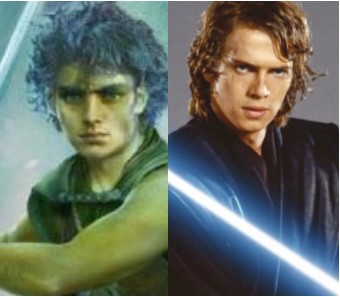
The Anakin Skywalker stand-in of Bowring's universe is a blue-haired infant born on neutral ground. Upon discovering this, the light side does the obvious ethical thing and sends agents to protect the family from the machinations of the-
- Holy crap, did they just steal a baby?!
Yep, they totally just stole a baby. While fighting darksiders with the same idea. And just to rub in that light emphatically does NOT equal good, they also had a magical tug of war. Using the baby.
Fortunately, this being a magical tug of war, instead of a splatter of gooey insides we get two whole infants, each with a separate aspect of the original kid's personality. Losara is stolen by the "bad guys" while Bel is stolen by the "good guys". So within the first chapter, we have a protagonist literally torn between light and dark.
And more importantly, we learn that everything I just told you is a lie. Nothing in this world is as
simple as it looks. Dark and light have nothing to do with morality, faith is a poor replacement for strategy, and no one's hands are clean in war.
![]() |
| Sadly, the old 'beard or no-beard' test has proved unreliable. |
That's great, you may be thinking, but what does that have to do with Star Wars? This isn't the first fantasy novel to challenge black-and-white coded morality (Sara Douglass and Ann Bishop are two of a few million examples). So lets look at the protagonists.
Yet this is just a symptom of a deeper problem. Bel, by his own admission, possesses no higher convictions or ideals. He couldn't tell you specifically why the light is better, because deep down, he doesn't care what side he fights on. The only reason he fights for the light is sheer chance. Had he been stolen by the dark, he'd have fought just as passionately for them.
![]() |
The one on the left has blue hair.
That's how you tell them apart.
|
So what does this mean? Aside from Bel's idiocies being a bit more justified than Anakin's?
Well... maybe it's a pointed commentary on what happens when you demonise your enemies.
See, both Anakin and Bel were born balanced between light and dark. Bel was initially unified with Losara. Anakin was told his purpose was not to fight for either side, but to keep both sides in check (see the brilliant Mortis arc of The Clone Wars cartoon series). However, they were both recognised as Chosen Ones and taken to be raised by the light, which is where things go wrong.
Both children were taught a very simple life philosophy: light is good, dark is bad. Losara was a "dark worm" that Bel is better off without, and Anakin's ordinary human emotions (fear, anger, love) must be purged. Understandable when you're raising the Chosen One, and you don't want him having doubts at a critical juncture. Yet utterly inadequate when dealing with real-world situations.
And predictably enough, when dealing with the complexities of adulthood, these simple codes completely fail them. Neither youth has any idea how to deal with a situation that's not black and white. Bel throws a tantrum when his girlfriend and father are (justifiably) arrested for committing crimes, while Anakin falls to pieces when he believes his wife is going to die and the Jedi either can't or won't help. And before you say anything, Vader isn't any better. He's simply Anakin adjusting his moral code to suit himself; if the Sith can help him, then the Sith are good and the Jedi are bad. He just swings from one kind of extremism to another.
It's only in Losara that we see any kind of balance, and that's only because he has an advantage the others don't. Unclouded, unbiased logic.
![]() |
| The dark sorcerer who performs human sacrifice and political assassination...and is the only guy who seems to know what he's doing. |
Perhaps the scene that best encapsulates Losara is his meeting with the dark gods. They demand that he serves them first, over and above even his people. He considers this - bearing in mind he is physically in front of the gods at this time - and replies "I'll serve you as well". Not an outright rejection, but an offer of compromise. Later he even suggests to Bel that they withdraw to their respective lands and ignore the prophecy.
That's Losara in a nutshell. Balance. Compromise. Coexistence.
Of course he'll murder your allies in an unholy ceremony and unleash an unkillable monster on your army if you insist on war. But the point is, he gave you an out. It's not his fault you didn't take it.
On the one hand this could imply the Jedi were right - lack of emotion is the way to go - but actually shows how wrong they were. Rejecting and demonising an entire aspect of one's self, religion, or country leads to ruin. The Jedi and Sith have been fighting the same war for millennia, in the same vicious cycle of retribution and counter-retribution. Bel and Losara's gods didn't do themselves any favours when they parted ways; they just made it possible to destroy each other.
Anyway, this leaves just one last question.
Is there a second version of Anakin Skywalker running around the Star Wars universe, maybe trying to fix everything his double broke?
Someone who encapsulates everything Anakin is not. Someone utterly brilliant, devious and genre savvy. Someone immune to manipulation and strategically unparalleled -
Holy crap. It's Admiral Thrawn.
![]() |
| Admit it. It's all starting to make sense now. |
Sunday, 23 October 2016
Goldenhand by Garth Nix
![]() |
| The Superman of the Old Kingdom. Awesome powers. Maybe a little bland? |
On the one hand, it has well-rounded characters, expands on the world-building of the Old Kingdom series, and ties up loose ends from previous books. I feel comfortable recommending it, both as a book and as appropriate reading material for teenagers.
However because its predecessors were so incredible, it suffers by comparison. Sabriel was a brilliant immersion into a dark world, Lirael was about living up to the demands of legacy, and Clariel was the tragedy of a young woman crushed by an unsympathetic culture. Whereas it's hard to say with Goldenhand because it never settles on any particular theme.
It has two storylines running side by side; Nick and Lirael's quest to understand Nick's abnormal magic, and new character Ferin's desperate journey to deliver a message to the Abhorsen. Both are good stories in their own right. Nick and Lirael's awkward romance was an entertaining exploration of two cultures while Ferin's quest was an intense race for time. But their different themes never quite form a coherent whole, leaving the book with a haphazard feeling. As much as I hate to say it, Lirael's storyline should have been shelved for a later installation and the focus shifted entirely to newcomer Ferin.
Why Ferin you ask? Because she has two things Lirael doesn't.
![]() |
| No powers. Totally kickass. Basically the Batman of the Old Kingdom Series. |
Secondly, Ferin is a foil to the villain. Like Clorr's former self, she was forced into a role she didn't want and that would ultimately have destroyed her. Given Clorr's hand in her suffering, there's also an underlying theme of cyclical abuse just waiting to be tapped. A showdown between the two of them would have carried so much emotional weight - far more than Lireal's vague, well-meaning sympathy.
As much as I love Lirael, this story should have belonged to Ferin. It would just be admitting what's already apparent, because Ferin completely steals the show. She's a fantastic character that could easily carry her own book and hopefully will get the chance oneday.
Regarding the villain Clorr, I don't entirely approve of the series' handling of her (making the only asexual a tragic villain is supremely dodgy) but I'm saving it for another day because I only have so much time to commit to this post. Suffice to say, I appreciate that she was such a well-rounded character, but felt Nix unintentionally fell back on unpleasant storytelling tropes.
I guess my feelings for Goldenhand are the same; I'm of two minds. While its various elements never quite gel together satisfactorily, each element on its own is excellent. Had the book focused on a single story-line and character, I'd be rating it much higher. As is, I recommend Goldenhand purely for fans of the original series. Which is everyone, right?
Saturday, 15 October 2016
Shattered Court by MJ Scott
![]() |
| The light, fluffy book somehow more pessimistic about gender roles than the high octane nightmare fuel that is Dark Jewels. |
It follows the adventures of Lady Sophia Kendall, a royal witch on the verge of inheriting the hereditary magic that will determine her future. However an unforeseen calamity sends her life off-course and her unnatural power makes her an unwilling pawn in court politics. With the help of royal guard Cameron Mackenzie she must navigate the dangerous undercurrents of royalty and religion.
Although much lighter and fluffier, Shattered Court has a lot in common with Anne Bishop's Dark Jewels series. Both depict cultures centred around women whose magic performs a vital function. In Dark Jewels a female-only caste called queens have the ability to rejuvenate the land, while in Shattered Court royal witches commit their magic to the protection of the land. But the conclusions each writer reaches are different.
Where queens enjoy nearly unchallenged dominance, royal witches can't even decide who they marry. In fact their magic makes them akin to valuable livestock, traded off to increase the status of whatever noble is currently in favor. Given the fact they once were very powerful, you can make a pretty good case for MJ Scott depicting the logical outcome of a society like Dark Jewels.
However, on closer inspection a key difference between the two roles emerges: the element of choice.
![]() |
| Given Anglion's situation, maybe this is why the Blood are so gung-ho about preserving female power? |
Whatever other issues I may have with the Dark Jewels, it's fair to say that the characters have a fair range of options. Being born into a queen doesn't mean you have to perform the duties of one. There's even some leeway with gender roles, as women can serve in courts and men can rule in certain circumstances.
Contrast that to Shattered Court, where royal witches have no choice at all in their duties. They undergo a ritual to bind their magic the minute they turn eighteen, information is edited to hide the ritual's true significance, and the binding itself is permanent. Unlike queens, who are only temporarily inconvenienced by rejuvenating the land, it's implied that royal witches never regain their full strength.
Given this difference, Shattered Court isn't so much a deconstruction of Dark Jewels as a 'for want of a nail'. The point is that while the abilities of a certain class might be valuable, that alone won't ensure they're valued as people. You also have to ensure informed consent in the performance of those abilities. To go for the obvious real-life connection, childbirth is an essential female-specific role but women haven't always had control over the process.
Maybe I'm over-analyzing (fine, definitely over-analyzing), but the world-building kept me reading long past my usual threshold for romance. It was a very easy read and the characters were likable. I was particularly intrigued by the Princess Eloisa who played her cards very close to the chest, making it impossible to tell if she was an ally or an enemy. Personally I hope she arranged everything, because that would make her a master manipulator on the level of Nick Fury.
Shattered Court might appear like harmless fluff, but it's smarter than it seems, and doesn't outstay its welcome. It ends on the perfect note to leave you hungry for more.
Saturday, 1 October 2016
A Dark Winter by Dave Luckett
![]() |
| In hindsight, he probably shouldn't have laughed at the Prince. |
Take its approach to characters for example. The typical hero is usually someone that initially appears unimportant (like Frodo, Rand Al'Thor, or Harry Potter), but is eventually revealed to be "the most talented, most interesting and most extraordinary person in the universe", to borrow a phrase. And there's a reason for that; being special is a powerful fantasy. People (especially teenagers) want to identify with Captain America kicking ass, not the Shield agents cleaning up after him.
But the protagonist of A Dark Winter starts out ordinary and stays ordinary. Noble blood is never revealed, nor is a gift for magic, nor a convenient prophecy. Willan is just a guardsman who insulted the wrong noble and was sent on a dangerous journey to the frontlines of a magical war.
This could have easily backfired into boring, but Willan's very ordinariness is what injects tension into the story. It feels like here's a real chance he might die. Add in his cynicism and crisp outlines of violence, and we have a swift-moving story about ordinary people existing in a world of magic. If they're skilled, careful and lucky, they might survive the monsters and zombies long enough to reach the hordes of goblin soldiers.
Willan's not the only one either. All the characters feel as if they're at sea in a world beyond their control. Silvus is haunted by a gift he doesn't want, Ruane is tangled in the schemes of his political rival, and Hrudis is caught in a cruel struggle where even her enemies are brainwashed victims. In a very real way it's a deconstruction of high fantasy's obsession with magic and war. They're not glorious or awe-worthy. They're a pain in the ass at best, and ugly death at worst.
A Dark Winter is a grounded, surprisingly logical story set in a fantastical world. Ultimately perhaps that's why it wasn't as popular as it deserved; it's a little too grounded in reality while being constrained by its target audience (Think Game of Thrones without the carnage and sex). However it's still a great book for teenagers and won't shame an adult to read. I'm certainly going to read the sequels.
Subscribe to:
Posts (Atom)